
Concert · 27 November · Espronceda Institut of Art & Culture
by Timo
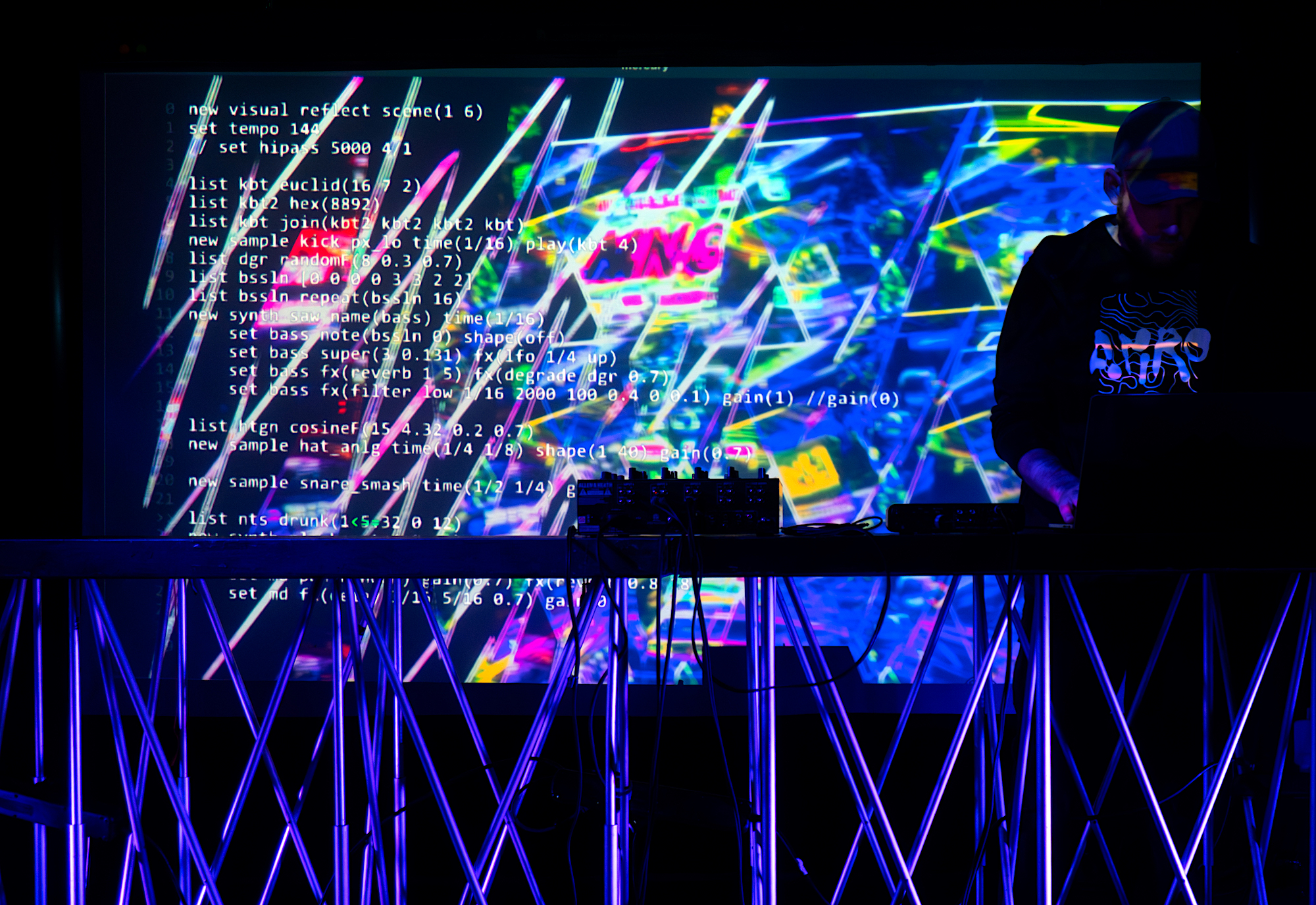
This piece challenges the concept of authorship and usage of recorded material through the lenses of "plunderphonics" (John Oswald), "organized sound" (Edgard Varèse) and "microsound" (Curtis Roads). With plunderphonics the material of a finished recording is considered as a timbre or instrument for a potential new musical work. With microsound we process the material at a small scale of time, being able to perceive the timbre, but not directly the origin. Through live coding, classification and sorting the sound is organised at a macroscale.
Remixing parts of recordings has resulted in the birth of lots of great music in genres such as hip-hop and electronic music. On the other hand using portions of other works has often lead to questions about fair use and is often considered copyright infringement.
This work balances on this line between using prerecorded musical material, but on a small scale, without making the used works to recognizable, but with the possibility of tracing back the source. It does this by using recorded music as a granular building block to reconstruct live coded sounds through the method of timbre classification and concatenative synthesis. Through this we listen to the reconstructed output instead of the original.
Timo is a digital artist, live coder, drummer and music technology educator from the Netherlands. He livecodes electronic music and develops algorithmic audiovisual compositions and installations. He also works with acoustic drums, signal analysis and machine learning in a live coding context. Timo graduated from the Masters of Music at the HKU University of the Arts Utrecht in 2019, where he developed the livecoding tool Mercury. He organizes meetups, workshops and algoraves as part of Netherlands Coding Live. He teaches creative coding at HKU Music Technology and Conservatory of Amsterdam.






Organized by Axolot.cat and the DARTS research group from UOC (Universitat Oberta de Catalunya).
Amb el suport de: Generalitat de Catalunya
Graphic Design and Website by Axolot.cat