
Oral Contribution · 26 November · UOC
by Matilde Sartori
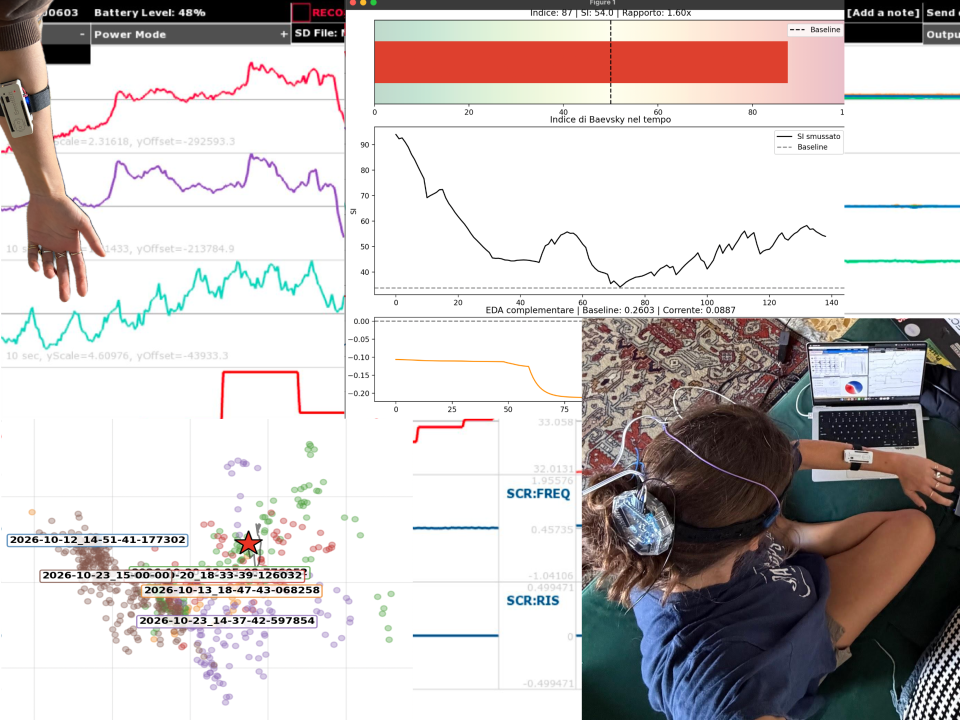
This research explores how real-time sound transformation can influence the affective experience in the context of non-idiomatic musical improvisation. It uses a situated map built from psychophysiological data as a framework to guide the improvisational process, through continuous modification of sound in relation to the position within that map. The process, rather than the result, is the main focus of the investigation. The continuous analysis of incoming signals guides the transformation, defining a direction that is updated throughout the performance.
The system is built from small, self-constructed models for the analysis and generation of sound characteristics and of the data produced during the research. The use of open-hardware and open-software technologies and biosensors links sound, perception, and physiological response, making the data an element situated and constructed within the practice. Body, sound, and improvisation become part of a process of situated exploration.
Matilde Sartori is an interdisciplinary researcher working at the intersection of sound, technology, affective computing, data and design. She holds a Bachelor’s degree in Statistics, a Postgraduate Diploma in Artificial Intelligence with Deep Learning, and a Master’s degree in Design Research. She is currently pursuing a PhD in Electronic Music at the Conservatorio G. Verdi di Como, in collaboration with the MMT Creative Lab in Milan. Her research explores the relationship between sound, situated affective experience, and technology, combining computational methods, sound practices, and physiological data.






Organized by Axolot.cat and the DARTS research group from UOC (Universitat Oberta de Catalunya).
Amb el suport de: Generalitat de Catalunya
Graphic Design and Website by Axolot.cat